A customer asks whether a jacket is in stock. The screen says three. The shelf is empty. The website says four. Somewhere in that gap a sale walks out the door. The Retail Insight Network reports the number from IHL Group: inventory distortion costs the industry roughly $1.75 trillion a year, about 7.2% of sales, with out-of-stocks making up almost two-thirds of it. A stockout is a data problem.
Retail systems integration connects your inventory, POS, accounting, CRM and marketing tools so one record updates everywhere at once, on live data. A sale at the till adjusts stock, posts to the ledger, updates the customer file and feeds the next campaign, with nobody retyping anything. Most businesses run the other way, and the gap between those two states shows up in the numbers below.
What retail systems integration actually is
The work is simple to describe. An order, a price, a stock count and a customer record each live in one system and update the rest on their own. Type nothing twice, and never show a customer a number you cannot honour.
The opposite is fragmentation, and it is the default. Across 300 US retail leaders surveyed by Priority Software in early 2025, 73% report data inconsistency because finance, inventory and POS are not connected. Only 27% run a single solution that covers all three, and among chains with physical stores, 85% struggle with data consistency. A retail-specific ERP rates high for 64% of these leaders, and 87% call customer experience a high or very high priority.
What disconnected systems cost a business
Patchworks and OnePoll asked 200 UK technology decision-makers in the sector to place their stack on a four-stage maturity model. Only 27% describe their stack as fully connected and scalable. Another 37% are mostly connected, and roughly 10% still run fragmented. No respondent reached the top stage, the one that self-regulates, per the Patchworks maturity model. Half of UK retailers lost £10,000 or more to disconnected systems in the past year, and 48% lean on manual workarounds just to get through peak trading.
The systems ranked hardest to connect, in the same Patchworks survey, are POS at 34%, customer relationship management at 32%, ecommerce at 27%, the order management system (OMS) at 25%, warehouse management at 24% and ERP at 21%. The symptoms follow: order errors at 23%, poor customer experience at 20%, and no visibility between tools at 18%. Those five are below, in the same order of difficulty.
Investment banks read the trend the same way. Houlihan Lokey’s 2025 market review says composable, headless architectures are how these silos get broken, and that a unified commerce model is becoming a baseline requirement, no longer a differentiator.
The five systems to connect
Every retailer runs the same five core systems, whether it is a single counter or a brand that sells across stores and online: inventory, the point of sale, the ledger, the customer database and marketing. Align them, and the rest of the operation lines up behind.
Inventory is the spine. Kyndryl’s readiness report calls inventory precision the base every other system depends on, and Linnworks’ State of Commerce Ops 2026 found only 37.2% of US mid-market retailers report excellent inventory visibility across channels. That number is the gap between in stock and able to sell.
POS is where the record starts. A modern point of sale holds customer, order, inventory and fulfilment data in one place, which is why Shopify describes an omnichannel point of sale as the shared spine of the store. When the till does not write straight to stock and the ledger, every sale becomes a second data-entry job.
Accounting is the ledger the rest must feed. POS integration posts each sale to the books as it happens, which turns the month-end close from a reconciliation project into a review.
Customer relationship management is where the customer lives. Salesforce’s Connected Shoppers Report finds that nearly 9 in 10 retailers have unified commerce initiatives underway, yet only 15% have fully realised their value, and just 17% of store associates hold a unified view of customer data. That customer data is what should flow back to the till and out to every channel, and our guide to customer relationship management explains the tool that stores it.
Marketing runs on the same record. When a purchase, a return and a restock alert all live in one system, a campaign can reach the customer who just bought or the one who almost did. Without that, marketing sends the same blanket email to everyone, the failure our guide to marketing automation software is about.
How the systems connect
Underneath the five systems sits one rule: each fact has one system that owns it, and every other system reads it. Whichever tool you pick for stock is the system of record for stock. A sale then moves into accounting, into the customer system and into the ecommerce store, each on a trigger or a schedule, the way NetSuite lays out the point of sale to accounting and customer flows. When a field changes, its owner pushes the update out and the rest follow. That is how these systems work.
Retail system integration comes down to three kinds of plumbing: an API the vendor already maintains, a cloud connector platform, or middleware that sits between two older tools. For a business with eleven to fifty staff, the decision is rarely about the technology. It is about naming who owns the connection when a record fails to sync, the goal our guide to building a single customer view keeps front and centre.
The platforms build for scale. Salesforce’s MuleSoft accelerator gives one view of sales orders across the till, the ledger and loyalty, with global IDs and orchestrated updates. It matters less which system you run than that every sale lands in the same place. The payoff shows in the data: 80% of leaders with a fully integrated core report real-time inventory synchronisation, and they cite profitability gains of 55 to 56% against peers still patching, per PMC and Retail Economics.
Where to start, without replacing anything
The fear is that aligning these systems means ripping everything out. It does not. The point is to unify the data while keeping the tools you already own, then integrate the flows one at a time. Name a system of record for each fact first, the way Lightspeed’s guide tells users to designate one source of truth and then decide what syncs and what does not.
Start in this order:
- Pick inventory as your first system of record, because stock touches every other number.
- Connect POS to accounting. It is the highest-value pairing for a small shop, and each sale posts itself.
- Then connect it to your e-commerce store, so online and in-store stock stop disagreeing.
- Bring the customer system in once the money and stock flows are stable, and let customer data feed marketing.
Small teams can start with the connectors already inside their tools. Zapier’s automations run the small-business end of the same idea: stock updates from each sale, low-stock alerts, and sales logged to a sheet or to QuickBooks. When you get to budgeting, our guide to where business process automation starts and what it costs carries the approach we use.
Questions we get asked most
What are examples of system integration?
A till that posts each sale straight to your accounting software is one. A till that deducts stock in real time and lets the website read the same number is another. A customer system that learns about returns and cancellations the moment they happen, so marketing stops emailing someone who just asked for a refund, is a third. Each one joins two tools that used to be retyped by hand.
Can you give me examples of retail software?
The categories map to the five systems above: point of sale tools such as Shopify and Lightspeed, accounting such as QuickBooks and Xero, ERP tools such as NetSuite and Oracle Retail for larger chains, customer relationship management tools such as HubSpot, and marketing tools. None of them matters until they share data, which is the whole point of this page.
What are the top 5 tools for connecting systems?
No one has published an authoritative ranked list, so here is the honest version. For a shop the shortlist is usually a connector platform such as MuleSoft or Zapier, your point of sale vendor’s own API, your online store’s connector, your accounting tool’s feed, and a data cleanup step before any of them. Most businesses have not adopted a connector platform at all, with only 13% on an iPaaS in the Patchworks survey.
What are the 5 P’s of retail?
Product, price, place, promotion and people. They are the five levers a shop pulls, and connecting your systems touches all five at once: product lives in inventory, price in the point of sale, place across stores and channels, promotion in marketing, and people in the customer system. When the five tools talk, the five P’s stop contradicting each other.
Do I need to replace my current systems to integrate?
No. You usually keep what you have and add the connections between them. You replace one tool only when it cannot expose an API or accept a feed, and that is a decision you make per system after the data map is clear. Start with the data.
How do the big platforms support retail integration at scale?
MuleSoft ships an accelerator that gives a single view of orders across the till, the ledger and loyalty, with orchestrated updates and global IDs. It is built for large, multi-brand and multi-country operations. The principle is the same at every size: one source of truth per fact, and every other system reads from it.
Where EFFENTII CORP comes in
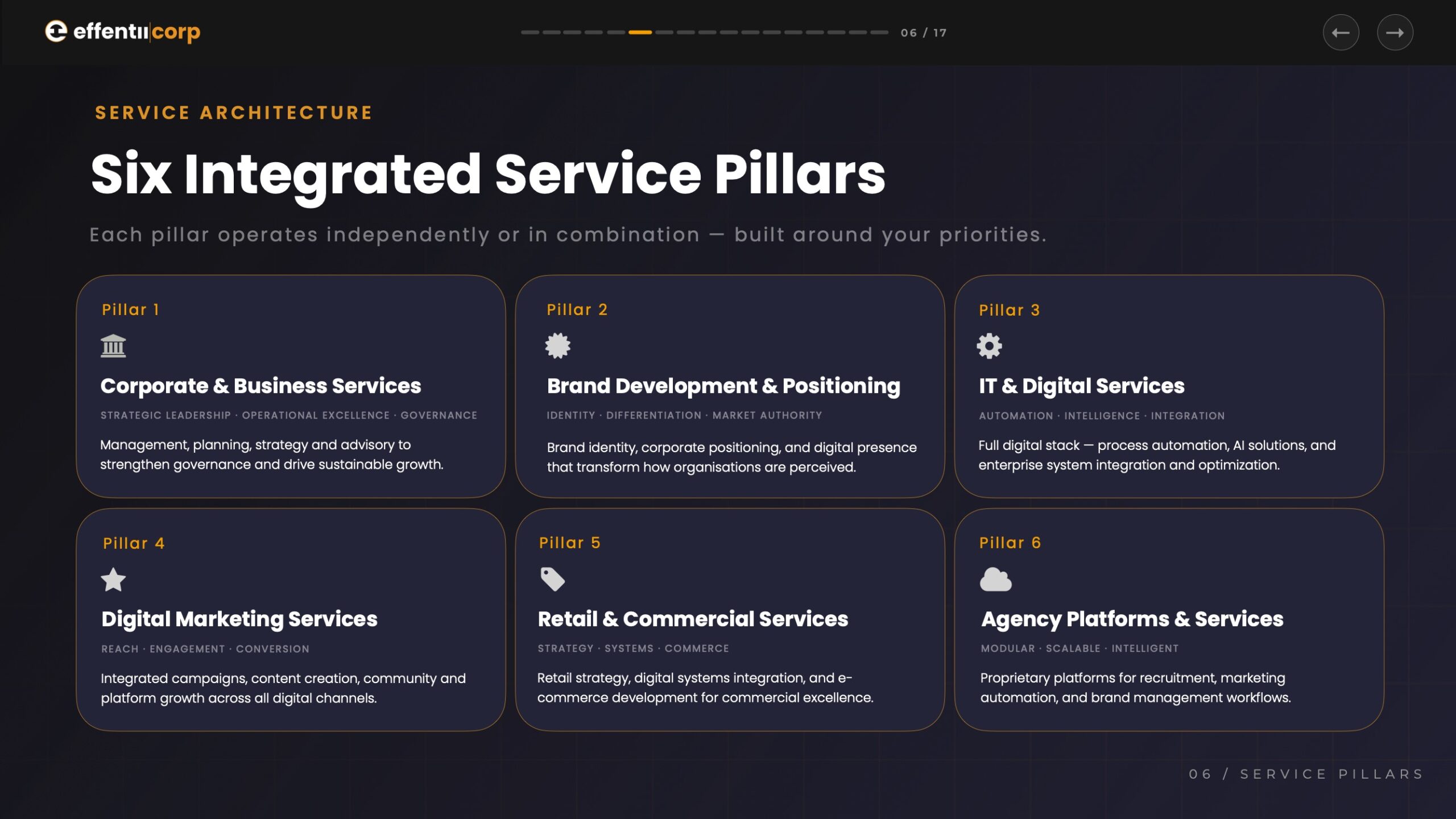
We start with the facts and their owners, then the connectors, then the exception queue that catches a failed sync. Your team builds the first flows with us and keeps the runbook when we leave. If the honest answer is that you should not buy a new platform this quarter, you will hear that first. Tell us which number is disagreeing today, through our digital and IT services.
If you are still mapping the tools you own, read our guide to choosing enterprise software to manage business operations.